TRINITY SUNDAY (The Dance Goes On)

•June 11, 2017 • Leave a Comment

dancing feet

…but those who wait for the Lord shall renew their strength, they shall mount up with wings like eagles, they shall run and not be weary, they shall walk and not faint (Isaiah 40.13)


ISAIAH IS such a poetic prophet (or two, even three prophets as literary theologians have suggested). But this is beautiful. The prophet has been telling of the dust-like nature of the nations, of human existence and history, in comparison to the greatness and vastness of the Creator, in whom all being, material, cosmic, spiritual, political, substantial, non-substantial, eternal, is held in perfect balance. The mountains, the sea and stars, wind and rain and all creatures commune with, in and through the Creator God, God beyond naming, whom just to speak of with any integrity requires poetry, art, myth and metaphor. Even these are not themselves sufficient but they open doors for the mind to pass through to a deeper awareness of what Is. In truth, great nations, kings, political leaders, rich or educated people all run out of steam and collapse, return to dust, under their own efforts. Even young, athletic men and women, in their physical prime, lose their strength and collapse after running, let’s face it, not very far. Even Usain Bolt is going to retire this year! No one can keep going long if they just rely on their own strength, their plans, schemes, training, personal or corporate expertise. But those who wait for the Lord, these will rise up like eagles on a warm thermal in the sky. Once again, the Bible teaches us the power of waiting for the Lord, contemplative prayer.


But this is Trinity Sunday, so a little theology might be helpful. Often, before a silent contemplation, I find it helpful to read some Scripture and think about it theologically for a while. I might then relate the reflection to something going on in the world or in my life, before letting all this go and falling into contemplation. Like music, painting or poetry, this kind of thinking often leads me to the door Christ speaks of in Revelation 3: “Behold I have left an open door before you, which no one can close”. That door, may we go through in our holy communion in a little while. May a little reflecting aid our path now.


The Great Commission – Matthew: Go therefore and make disciples of all nations, baptizing them in the name of the Father and of the Son and of the Holy Spirit, and teaching them to obey everything that I have commanded you. And remember, I am with you always, to the end of the age.’


Again, with poetic and beautiful language, Jesus gives his final instruction to his Apostles before Ascension. One of the biggest problems through the Christian era, has, I think, been the failure to understand the poetic and mystical nature of Jesus’ words and the teachings of the Hebrew Prophets. Instead, Christians, apart from the mystics, have almost always thought and taught in literalistic ways. Father, Son and Holy Spirit have been separated from each other and given delineated personification. This really misses the point of Jesus’ teaching and invents something completely different. So, what has been transmitted usually is a kind of hierarchical faith in an all-powerful, king-like man with a long white beard sitting on a throne, who sends his son to earth and blows some kind of strange creative and spiritual wind around the place, which the church has never quite managed to get a theology for. This has more to do with the almighty Zeus and the gods and goddesses of Ancient Greece and Rome than anything Jesus said or illustrated! Much of Western theology has been based on Greek and Roman philosophy, not on Jesus Christ or even the words and deeds of Jesus of Nazareth.


So, if Jesus did not mean that the church should go out and baptise people in the name of Zeus, Apollo and the Holy Musai (muses), then what was this Trinity he spoke about and which we celebrate together today?


The inheritance of Greek philosophy, through which religion has been lensed in the Western world, has led to an inherent dualism in Western conditioning. Something is right or it’s wrong, dark or light, good or bad and so on. This informs capitalism, competitive outlooks, hierarchical politics, nationalism, religion and just about everything else. But Jesus’ teaching and the parables and histories of the Bible are non-dualistic. There is much human dualistic thought recorded and parodied in the Scriptures but the flow is non-dualistic. The Divine which emerges through below the surface reading is non-dualistic. Jesus is inclusive, universal, cosmic.


The Creation story in Genesis gives us a clue from the outset by using plural pronouns: “Let us create in our image” (Genesis 1:26-27). Of course, this is problematic for monotheistic Judaism and Christianity and it took centuries to work out the doctrine of the Trinity. The Church Fathers (eg Gregory of Nyssa, Basil of Caesarea, and Gregory Nazianzen) of fourth century eastern Turkey finally turned to a word from Greek theatre, perichoresis—circle dance—to describe God’s character, God’s being: relationship and communion. In the beginning was relationship.


Richard Rohr has written, “God is not the dancer but the dance itself! God is much more a dynamic verb than a static noun. God is constant flow. You don’t even need to understand it intellectually or theologically to participate in the flow of God. You are already there. Within your heart, body, and mind is an implanted flow toward life, goodness, love, communion, and connection. “Sin” is quite simply any resistance to that flow.


Trinity Sunday, then is not about any complicated formula for baptism or for literally describing how God is three and yet one, for the sake of monotheistic integrity. It is about dance and flow, communion and connection.


We are never separate from God or from each other, even from life or death, not ever, though we often twist our minds to think that we are, or else we have them twisted for us!


Let’s go now to our Eucharist, Holy Communion, “And remember, I am with you always, to the end of time…” Oh, and, by the way, time that begins and ends, that’s just an illusion imagined by linear-thinking historians…The dance goes on…

St Patrick knew the dance very well. Let’s imagine a moment St Patrick and the Gower saints, who slept with their heads on the grass or in a bed of leaves, on the cliff edge or under a tree, who moved with nature’s dance to take the gospel of truth so all with feet to dance may…dance…

Christ with me, Christ before me, Christ behind me, Christ in me,
Christ beneath me, Christ above me,
Christ on my right, Christ on my left,
Christ when I lie down, Christ when I sit down, Christ when I arise,
Christ in the heart of every man who thinks of me,
Christ in the mouth of everyone who speaks of me,
Christ in every eye that sees me,
Christ in every ear that hears me.


dance in peace


RETURN TO JESUS MOVEMENT (a contemplation on the Highlights of Church in Wales Governing Body Synod)

•June 7, 2017 • Leave a Comment

fire-wind

You can see “Highlights” here: http://cinw.s3.amazonaws.com/wp-content/uploads/2017/05/Highlights-April-2017-English-ONLINE-FINAL.pdf

Post Easter Highlights – Governing Body of the Church in Wales – sub title – ‘Put Evangelism at the heart of your ministry’. Various members of C in W governing body are quoted then as to what they think this means. Like any group of quotations, you might find some of them insightful, others less so. Personally, I don’t find much of interest here at all but I notice Bishop John has been given the front page and there is one moment in what he says that explodes in me like light – “We need to become, afresh, a Jesus movement. But – and this is a big ‘but’ – we have to begin with ourselves, we have to re-evangelise our life – because unless we really know what we are about…there is little point in trying to reach out to others and to invite them in.”

Look, the rest of this document is just discussions among church leaders, basically buzz-wording about how to reach out to others and invite them in. But Bishop John has cut through the strategies and imaginings and pontifications to the core of what the church is supposed to be about and hopefully what the church is on her sometimes beautiful, often ugly journey toward becoming, what she started out as being when she received the breath of Christ, Christ’s-self, a Jesus movement. That is, a church which moves absolutely in the flow of Christ’s being, Christ’s consciousness, and offers to carry the whole of humanity, the whole of creation, the world and the universe, right into the very heart of God. And Christ has told and Christ reveals to us everywhere, that that flow to the heart of God leads right into the heart of our own being, into the atomic micro-element, if you like, of being. We are whom we are becoming.


So how do we return to being Jesus Movement? Well I am sure it is not about converting anyone to our religion. Many people in the world, many in our villages here in North Gower, say they are interested in the spiritual but not in religion. There is a growing awareness, a rising from the unconscious to the conscious minds of people, that the programmes for material success and fulfilment that we have been taught to follow, do not lead to happiness or any kind of profound fulfilment. Western capitalism forgot about the spiritual nature of human being, but human being is waking up and beginning to remember. We can see evidence of this in the breaking down of political and institutional allegiances and the questioning of their motives and honesty. But there is danger here and I believe the church, though, institutionally, might quite rightly be being brushed aside, has a crucial role to play. And I believe the church can play this role and will play this role. But it has nothing to do with converting people into anything, which is the basic precept of evangelism. It has, instead, everything to do with teaching the people to pray. It’s that simple. Teach people to pray, so that they may know God, not through any theories or laws but through direct experience. It’s simple and it’s beautiful. It requires no strategies or tactics, no politics, no stressful administration.


It’s right here in our readings today. It is right here in any reading, any Sunday, any morning or evening prayer, anytime we use Scripture. But here as we celebrate Pentecost, it’s the outpouring fire on the Apostles and indiscriminately on the people of Jerusalem, the Paracletic breath of Christ in John’s Gospel, the gifts of the Spirit described in 1 Corinthians, the creative Wisdom, Hochma, Sophia, in Psalm 104. What puts us in touch with all of it, is prayer, contemplative prayer. Between Ascension and Pentecost, Acts tells us the Apostles and the women who followed Jesus, the very Jesus Movement itself, spent their time, in the upper room in Jerusalem, “praying constantly”.

How were they praying? Well, Jesus had taught them how. They’d witnessed him going alone to pray in the morning early and in the evening late and they’d asked him to teach them ~ Matthew 6: When you pray, go into your room. Close the door and pray to your Father, who can’t be seen. Your Father will reward you, because he sees what you do secretly. “And when you pray, do not heap up empty phrases as the Gentiles do, for they think that they will be heard for their many words. Do not be like them, for your Father knows what you need before you ask him. Pray then like this: Abba… Intimate, loving, simple, he is teaching them contemplative prayer. There is nothing we can experience on this earth more beautiful and more fulfilling than to pray like this. If we can pass this on to people, then we are doing the most beautiful thing we can do, we are taking our place in the flow; we are quite simply being the Jesus Movement. We are artists. Great art is great because it touches the soul, leads you into contemplation, the deepest prayer. By the grace of God, we can teach many people to pray.

Let’s practice a little now and then let us receive together God’s body, God’s blood, God’s life, God’s consciousness…remember who you are and who’s you are…

You can practice this just about anywhere, any time.

Be still and know that I am God – (silence – 2 mins? – you decide)

Be still and know that I am – (silence)

Be still and know that I

Be still and know that

(reduce each time until just ‘Be’)

longer silence – just Be – be conscious but try not to think, about anything, just be. You are wth God always. God is closer to you than your own breath.


ASCENSION! (a Breakfast Eucharist at St David’s little church on the North Gower Marsh)

•May 25, 2017 • Leave a Comment

ascension dali    AFTER THE atomic bombs of 1945 on Hiroshima and Nagasaki, the artist, Salvador Dali was deeply disturbed by the possibilities for evil and destruction that science afforded. “Since that time,” said Dali, “the atom has become my favourite subject of reflection. Many of the landscapes painted over this period express the great fear I felt at the news of that explosion. I was applying my paranoiac-critical method to the exploration of that world. I want to see and understand the power and hidden laws of things so as to gain control over them. In order to penetrate into the marrow of reality I have the genial intuition of having an extraordinary weapon available to me — mysticism, the deep intuition of what is, an immediate communion with the whole, absolute vision through the grace of truth, by divine grace.” I guess only an artist could use language like that!
Anyway, Dali painted the Ascension in 1958 but it is part of series of Christ paintings that he said were a response to a cosmic dream he’d had in 1950, a dream which he said was in vivid colour. It is certainly a mystical painting. Christ’s ascension, rather than a literal rising into the clouds from the top of a mountain, is for Dali about Christ’s passing not from the material world into the heavenly world, but into the very centre of the atom. Christ is not leaving the world, he is entering its atomic structure. The ascension is not so much a movement up and away but a movement out from the singular flesh and being and into the very core of all flesh and being. Notice that though Christ’s body is resurrection pure, beautiful, healed of the wounds of torture and death, his hands and fingers are extended, claw-like, in anxiety and pain. This passing is no easy passing because Christ must not only go through the horror of First Century crucifixion, which we know he already has, but through the modern horror of nuclear and atomic manipulation by humankind to evil ends. Christ has conquered death and a broken world is being restored and yet humankind is still hell bent on destroying the world and everything in it. Dali’s wife and muse, Gala, is above the atom, gazing at Christ’s face and weeping. As usual, Dali does not let us gaze on Christ’s face. But the muse has mystical insight; she does see the face of Christ and it makes her cry. Art, beauty, feminine compassion, the antidote to the masculine war games of atomic bombing, can only look on and weep, crying for the hopelessness of the progress-crazed human condition, but moved also to tears of joy in the realization that the Cosmic Christ is in all and, though his struggle is potentially eternal, he will never give up. Not only that, but the mystic one, who gazes on the face of Christ, will be drawn by the force of Christ’s movement into the same atomic portal into which he goes. Christ does not leave us orphaned, he has gone to prepare a place for us and he will come and take us to himself. The Holy Spirit overarching the atom and Christ links the weeping woman with the atomic Christ, her head is the Spirit’s head, her body is the Spirit’s body. I am in my Father, and you are in me, and I am in you. There is no separation between the ascended Christ and the mystic. The mystic is he or she who prays through the Spirit in us. If you go for a walk and just notice, with wonder, the beauty of a flower, the song of a bird, the texture of a leaf, the Christ in the eye of the stranger or known one, or even just the material in the concrete slab you walk on, then you are, in that moment, mystic!

Ok. What am I trying to say? Huh?

I don’t know what happened on that mountain in any literal way. But I don’t think it is important to know how it works. The ascension is about truth far deeper than historical or scientific facts or any other kind of knowledge humankind can work out for itself. If Christ stayed on the mountain, then by now the whole world would be at his feet worshipping him. But that would be meaningless. Christ would be no more than an idol onto which all the world would project its collective and individual responsibility. This would be abeyance to supreme power but it would not be love. Christ’s purpose, Christ’s being, Christ’s message, Christ’s new commandment, is love. Christ ascends from the idol so that he comes to us in every cell, every atom, every particle, in the very DNA of the universe. This is how much Christ loves us. Well, he loves us more than that but I think I’ve stretched my capacity for language enough now and it’s nearly time for breakfast. Blessed Ascension to you!

Amen.

LIVING WATER

•March 20, 2017 • 2 Comments

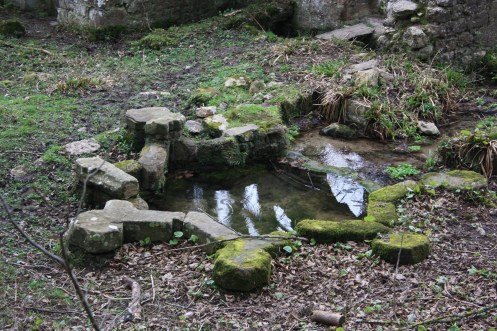
ffynnon-fair-cefn-001.jpgTHEY SAID to the woman, ‘It is no longer because of what you said that we believe, for we have heard for ourselves…

The Samaritan woman is able to attract the people of her village to the Messiah because she has met him and received from him the Living Water. She is able to lead the people to where he is, that they might also drink. They meet Christ, drink the Water and so believe. They are Saved.

But what does all this mean for us? What is the Living Water? How do we get it and how do we bring the people to receive it for themselves? After all, we can’t just go down to the local well and meet Jesus there, can we? And we can’t then run back to Crofty, or Llanmorlais, or Pernclawdd, or Llanrhidian and tell everyone to come and meet the Messiah.

We can’t even go down to St Illtyd’s well by Llanrhidian church and get that water either, can we? Well, no, and then again, yes we can. We can do all of these things.

There are clues all over the place in our readings today and throughout the Bible. But the clues are particularly intense in John’s Gospel. Here’s one very powerful clue: ‘…the hour is coming, and is now here, when the true worshippers will worship the Father in spirit and truth… God is spirit, and those who worship him must worship in spirit and truth.’

And another – ‘Meanwhile the disciples were urging him, ‘Rabbi, eat something.’ But he said to them, ‘I have food to eat that you do not know about.’

Jesus teaches as a spiritual master teaches. There is nothing literal here. Jesus uses metaphor to take us to the deeper reality, to the essence of being. This essence of being is not mortal, it is Divine. True being is enlivened, animated by Holy Spirit. It is the true nature of our being, made in the image of God. To become conscious of the animating Spirit is to drink of the Living Water. This is the Water for which all souls cry out, consciously and/or unconsciously. Everyone we can ever meet in our lives is thirsty for this Water. That’s why Jesus says ‘the harvest is ripe.’ But he also says ‘the workers are few.’ A traditional interpretation of that is that not enough people are willing to go out and bring in the harvest for God. For me, that’s not quite right. There have been times when the church has been pumping with ministers, congregations and evangelists. But I don’t think all that necessarily brings in the harvest at all. I sense that what Jesus is talking about is that there are but few who are qualified to do the harvest.

This qualification is not any kind of material or worldly qualification. It can’t be gained by studying theology or training to be a priest or evangelist. It can’t be gained by working out the most profound philosophical or scientific argument at any given time or even of all time. Rumi says …the Man of God is not learned of book but made wise through truth. The qualification Jesus speaks about, the only qualification that is relevant, is simply that of drinking the Living Water and in so doing to become conscious. That’s it! That’s all. In becoming conscious, we worship in spirit and truth. All the trappings of religion, education, false perception, judgemental thinking, need to control or cling, well they just crumble and die, fade into the dust, blow away in the wind. When we have this Water, when we worship in Spirit and Truth, we are ready to make the harvest. Until we do it, it doesn’t matter how ripe the harvest, we can’t do anything to help.

I mentioned Illtyd’s well and I truly believe you can find the Living Water there. I expect Illtyd did, just as St David did on the cliffs of West Wales and Teilo in the Pwll Du Valley. But they found it not by any kind of magic. It was their sensitivity to the thin place. If the well helps you to be sensitive then go there. But the true thin place is within your heart. You don’t actually need to go anywhere to find it. Just stay, right here, right now. The gate to the kingdom of heaven is open. The harvest is ripe. God bless you.

Take a System Break

•March 14, 2017 • Leave a Comment

THE WORD world in the Gospels doesn’t mean creation. It implies the systems that human beings come up with to administer their societies. So, it really means, The System or else it sometimes refers to the people who are caught up in it. The System is almost always going to be in diametric opposition to the Way, the Truth and the Life, by its very nature, that it is conceived in the first place as a means of control and stabilization. The conscious follower of Christ, born (again) of the Spirit, is like the wind, not controlled nor stable. (S)he is in the world but not of the world. Hiraeth for the kingdom of heaven is the emotional mist in the psyche of the follower of Christ.

So, who are we, if we say we are Christ’s body, and what is our purpose?

If we just take a break from our programmed, religion-doctrined ideas about God, it is not too difficult to realise that much of our language about God Almighty, Lord, King etc is misleading. I am not saying it is wrong to make intercession to the Lord God Almighty, we know when we do that there is a transference of meaning in the power of those words. But what I am saying is let’s do it consciously. Let’s notice, when we pray or read, the vulnerability which God chooses to reveal in the New Testament. Jesus takes no System titles for himself and he does not seem to envisage his followers taking over the world. If we take away our indoctrined lenses, we can see in the Gospels that the most Jesus seemed to hope for is that his disciples might become a little flock (Luke 12:32), or like a little salt, leaven or yeast (Matthew 13). Jesus imbues the patience and humility to trust a slow leavening process.

We are programmed to worry that our churches are not full of people waving their arms in Christ-praising ecstasy. But that was never the plan! Christ’s hope was and is that there’d be just enough people who, like Abram in our Hebrew Bible reading today, Paul in the New Testament, or like the psalmist, are prepared to walk out of the safety of systemic country or kindred, lift up their eyes to the hills and go faith to be the leaven in the dough and so save the entire world from blind delusion and self-destruction.

Muster live at Club Integral

•March 2, 2017 • Leave a Comment

and to think it was once enough for me to listen to the Jesus and Mary Chain. Thank you Dan

danpowelldanpowell's avatarDan Powell

James and I did Muster at The Others in Stoke Newington a couple of weeks ago, we liked it enough to put it on Soundcloud. I also got to play in a trio with Annie Kerr and Kev Moore at the same event as Gus Garside was indisposed (by Storm Doris, he was stuck in Manchester).

View original post

STOLEN CHILD

•February 25, 2017 • Leave a Comment

“Come up to me on the mountain, and wait there…”                                                                                                                            ~ Exodus 24.12

feet in the wild.jpg

Come away o human child, to the waters and the wild…

     “…WITH A FAERY, hand in hand, for the world’s more full of weeping, than you can understand…” I love the bardic melodies in the poems of the Irish mystic, WB Yeats. They feel to me as natural as the sea. Yeats’ words seem to dance like the notes and grace notes of a Gaelic reel, so free and yet so deeply laden with the hiraeth of a wandering soul that somehow walks the shrouded lines between catching a glimpse at something and the realisation that probably that something can never really be retold. The voices in the poems seem at once lonely and yet wholly befriended and befriending. In Stolen Child, the reader is called, through Celtic mythology, into contemplation and so to discover a more innocent wildness of being than the sad and disconnected world that has become the political and social landscape of our lives.

Lent is a call to our deeper selves, urging us into the deserts and wastelands of our consciousness, offering us the space in which we might remember or discover whom really are, beneath the layers of anaesthetic sold us so easily and enticingly by the philosophic traders in the material. “Come up to me on the mountain, and wait there…”, says I AM   to Moses in our reading from Exodus. We are told the prophet stayed there 40 days and 40 nights.  “Jesus took with him Peter and James and his brother John and led them up a high mountain, by themselves”, remembers Matthew in the Gospel passage. On the mountain, in the wild, God shows what is real. For the one who will stop a while and steal a gaze into the mist and so be graced “eyes to see”, the one who contemplates by opening the heart and so finds a blessed descent from the noisy mind, who listens for the melody of the poet, for this one, and perhaps only for a moment, the veil of truth is lifted.

If all this sounds a bit exclusive, and Moses and the fishing-for-men big three does, doesn’t it – well, according to the Gospel, if the Gospel really is the Message of Jesus Christ, it is not exclusive at all! Every breath and every word on Jesus’ lips breathes and teaches that God wants to reveal God’s self to every single one of us! So, come on. Take some time. There is much going on in Gower this Lent, in churches and outside. Come with us or travel alone but anyway come away o human child, to waters and the wild

TRUE RELIGION (BREAK THE YOKE)

•February 3, 2017 • 1 Comment

Is not this the fast that I choose: to loose the bonds of injustice, to undo the thongs of the yoke, to let the oppressed go free, and to break every yoke? ~ Isaiah 58. 6-7

breaking_free_from_sin_by_chaseroflight-d5ugckd

       RELIGION and spirituality may walk hand in hand, like lovers, and sometimes they do. All too often though, religion is arrested and enchained by rulers and oppressive control systems. The various prophets recorded in Isaiah speak into this condition. Paul speaks into it. Jesus speaks into it. Every biblical reading, any Sunday or any time we open the Bible, speaks into it. Religion contains many gifts and it can set us free or it can be used to tie us up and disable our spirit. Then we might use religion ourselves to close down our hearts and drug ourselves with programmes of fake happiness, not because we want to but because unconsciously we are trained that way. Jesus says, “Wake up!” “You are the salt of the earth…You are the light of the world…”

We all know what is real, deep inside. When you go into the garden this week, you might be filled with thoughts of what you must do to prepare the garden for Spring and Summer and you might start clearing, digging, planting… but then suddenly you might notice the earth, the life around you, and sense, in a way words can’t say, that you are one with the earth and the breeze and the life…and you will fall into prayer. And after a while, or straight away, your prayer will have no words. And you might know that you are in the presence of God. You might even realise that that Presence is not separate from you, that actually nothing that really is, is separate from you. Ah now, the chains? Where are the chains? Just let the prayer and the noticing go on… Heddwch chi…

FEED ME

•January 28, 2017 • Leave a Comment

‘Go now to Zarephath, which belongs to Sidon, and live there; for I have commanded a widow there to feed you.’

 ~ 1 Kings 17.8-9

whd2

“I have nothing baked, only a handful of meal in a jar … for myself and my son, that we may eat it, and die.”

       GOD has told his mightiest living prophet of the day to go somewhere, it could be anywhere, and he will be fed by a woman whom God himself has prepared for the task. But when Elijah gets there, he finds the woman hasn’t really got any food at all and she doesn’t seem to be aware of any high purpose she might have. In fact, she has given up any expectation of getting through the famine of a long drought and simply wants to scrabble together a tiny last meal to share with her child before they lie down together and wait for death to take them from their misery. No doubt the last thing she thinks she needs right now is a wild-eyed, matty-haired man of God asking her for something to eat!

We could think about Elijah’s faith in following through on a seemingly hopeless situation but this isn’t really about him. He’s been fed by ravens in the wilderness and sucked water from a rock to quench his thirst, so this probably doesn’t even seem too unpromising to him now. No. This is about the woman.

When Elijah commands her to do as she says she intends to except that she must feed him first, she does what he says! Why? Is she just so desperate that she’ll do what this loser says because he is forceful enough, and she and her son are going to die anyway, so what’s the point in arguing about it? Well, no doubt there is a Dylanesque element of, “When ya ain’t got nothing, ya got nothin’ t’lose” about it, but there is something more than that here. When the man of God speaks to her, there is something deep inside her that knows that what is happening to her is of God.

Why?

Because deep down inside, every creature, everything that lives, knows the Maker and recognizes authenticity. God really has prepared every single one of us!

        What will it take to make us see?

                                                      And then if we see, what are we going to do to wake the others?

Gwyr, Listen To Me O Coastlands

•January 15, 2017 • Leave a Comment