NOT FAR FROM THE EVER AND EVER

•November 5, 2018 • 1 Comment
Vitruvian Man

“Almighty and eternal God, you have kindled the flame of love
in the hearts of the saints: grant to us the same faith and power of love…” (today’s Collect)
“One of the scribes came near and heard them disputing with one another, and seeing that he answered them well, he asked him, ‘Which commandment is the first of all?’ (Mark 12.28)

THE SCHOLAR approaches Jesus in this morning’s Gospel reading with a testing question about the Torrah. It is a test of orthodoxy perhaps and is legalistic with moralistic undertones. Religion to this day is often seen in such a way, like a scaffold of ‘correct’ beliefs and rules designed to help ‘believers’ join the dots to salvation and so be worthy to enter some variously prescribed version of after-life eternal bliss. For Christians, largely because of words often found in the gospels on the lips of Jesus, this is often thought about in terms of kingdom of God, kingdom of heaven or just heaven. Due to political dominance through the ages of empire versions of Christianity, earthly kingdom type imagery has often been efficacious, leaving many generations spiritually groaning under the weight of impossible morality. Of course, this is not surprising; people whose default setting is an inherent sense of failure to live up to pre-programmed ideals, are susceptible to authoritarian control.
But Jesus says the scholar is not far from the kingdom of God. This law-scribe has shown Jesus that actually he can perceive the love of God beneath his own religious and social programming. For Jesus, this kingdom has nothing to do with earthly kings or political leaders. Malkuthach, central to Jesus’ message and normally translated “kingdom,” is really about what guides us in our souls; it is that which empowers us to go forward in the face of all difficulties, a creative potential aching to be realised. Malkuthach is linked in Aramaic to shamayin – heavens – less a place than a movement of being, like “light and sound shining through all creation” (Dr Neil Douglas-Klotz).
Jesus was never a teacher of morality but rather he opened the consciousness of whoever had ears to listen, so that they might see God within themselves, timeless, eternal, and so be able to enter in this life the kingdom state, consciousness or guiding principle of God. In doing this a person becomes ripe to inherit oneness, completeness in the ‘world to come’.

THE LIVING WORD (BIBLE SUNDAY)

•October 27, 2018 • Leave a Comment

kells

BY THE FINAL SCENE in the Book of Job, the title character has been stripped to the core. Everything he thought he knew about life and God, religion and morality, righteousness and just rewards, politics and philosophy, has been ripped away from him, along with his family, his wealth, social standing and everything else. Finally he is able to come to God and simply let God be God. Similarly the blind beggar in Mark’s gospel came to Jesus in the street, simply knowing God being God in Christ and asking Christ to open his eyes. All is restored and more to Job and to the blind beggar the moment they let go all sense of self-righteousness and instead trust completely in God. This is the meaning too of the psalm, where the ‘poor soul’ of the singer-poet cries from the depth of her/his being and is heard.
There is much to interest us and teach us in reading the Bible. But to keep it only on the level of mind and intellect would be tragic, stifling to our life’s walk with God. No doubt, this Bible Sunday there will be enough debate in churches and outside them about Scripture and which translations are best and what we can learn about being a Christian, living a ‘good life’ etc. Fine. But if it ends there, then it won’t bring anyone any closer to the living God. You have heard the Bible described as the ‘living word’ and for sure it has the power to give us life. So let’s make an intention from today, if it’s not already done, to read a little every day, not just with the brain and its questions but with our ‘poor souls’. Read a few sentences, not too much, 3 or 4 times, slowly, letting go the need to know, just asking God to open the eyes of our souls.

MINDS OF THUNDER, BE STILL

•October 20, 2018 • Leave a Comment
Ignatius_of_Antiochie

“Grant, we beseech you, merciful Lord, to your faithful people pardon and peace, that they may be cleansed from all their sins and serve you with a quiet mind” (from today’s collect)
“And they said to him, ‘Grant us to sit, one at your
right hand and one at your left, in your glory.’” (Mark 10.37)

THERE WAS much noise in the minds of James and John, whom Jesus nicknamed ‘Boanerges’ (Sons of Thunder). Jesus loved these fishermen for their passion and rawness but in our reading from Mark today they mirror some of the noises in all our minds – the conscious/unconscious programmes of competitive societies, the conscious/unconscious neediness for attention, security, notoriety, recognition, acceptance, wealth, power and so much more.
James and John have been with Jesus some time now and experienced the highs and lows of life on the road with the charismatic Christ, loved by outcasts, opposed by the rich and powerful. They have come to understand deep inside that the power of God is with them in this Christ, though their minds struggle hopelessly to make sense of how and why. But their guts and hearts sense without doubt that the religious and secular powers that rule their material lives are nothing in relation to the power this Jesus of Nazareth embodies and their minds can only equate that with his inevitable coming into recognized dominion as king of the world. James and John simply want to claim their reward and be sure of prime seats when the kingdom comes to pass, as it surely soon will. Jesus quietens the thundering minds of his students and gives them hochma, Wisdom, just like Yahweh speaking silence out of the whirlwind in Job’s mind in our OT reading this morning.
In today’s collect we ask God to give us “quiet mind” and so be able to serve God. Our minds are assaulted now more than ever by incessant, demanding media even before the noises of our own egos kick in. But God is the same now as God was in First Century Galilee, 1st/2nd Century BC when Job was written or any other time in history. Beneath the thunder and the whirlwind, when we make the space and stop, breathe, be still, pray without words, there is a still small voice in each one of us. It is the voice of Christ, Jahweh, All That Is, and it says, “Do not be afraid. I love you. Despite all the programmes that distract you, I AM.”

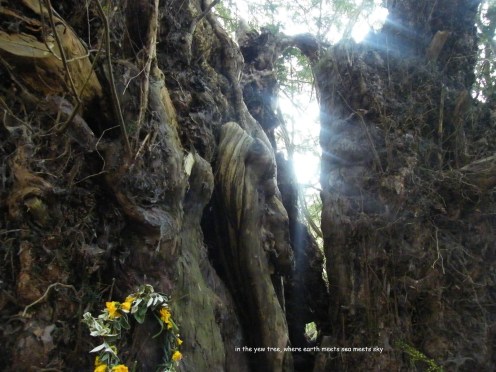
yew.jpg

THE HIDDEN GOD AND THE HARVEST

•October 12, 2018 • Leave a Comment
looking for God

‘If I go forward, he is not there; or backward, I cannot perceive him; on the left he hides, and I cannot behold him; I turn to the right, but I cannot see him…” (Job)
“My God, my God, why have you forsaken me? Why are you so far from helping me from the words of my groaning?” (Ps 22)

THE LEAD character in the Book of Job and the voice of the Twenty Second Psalm are united in one thing, their sense of loneliness and abandonment by God in their hour of need. Of course, it is the opening phrase of Psalm 22 that the gospels of Matthew and Mark place on the lips of Jesus as he hangs on the cross, dying (“əlahí əlahí ləmáh šəvaqtáni?”).
If we are honest with ourselves, perhaps most of us can recognize moments of doubt and pain in our lives where such words well describe the way we felt. Have you called out from the night of your pain and wondered, is there really anyone listening? Does the universe really care? Similarly, in our prayer life, however disciplined we might be in making the spaces in our lives for prayer, probably more so in this case, there are times of dryness, when it might seem that God is hiding from us or has simply absented Godself from our lives. The harder we pray, the further away Christ seems to get. For some, this can be the end of the road as far as faith is concerned. For others it is really the beginning.
What should we do in the dryness? Pray more. Let the humility that comes with feeling abandoned teach us, seed us, nourish and re-birth us. The temptation is to pray less, stop even. But the dryness is a gift. God is closer than our own breath. In humility, we can seek God for God’s sake, let God be God. Be still. Be patient. As Brother Titus told some of us on Caldey Island a couple of weeks ago, “Just let it be”. Let it be and let the words of prayer dissolve into a wordless gazing, with awe and wonder, as God tills the soil of your soul for the harvest he will reap in you and through you. It will come soon.

The Name of love

•September 29, 2018 • Leave a Comment
building-bridges

But Jesus said, ‘Do not stop him; for no one who does a deed of power in my name will be able soon afterwards to speak evil of me. Whoever is not against us is for us.’

THE FAMOUS Cistersian monk, Fr Thomas Merton wrote, “… when one breaks through the limits of cultural and structural religion – or irreligion – one is liable to end up, by ‘birth in the Spirit,’ or just by intellectual awakening, in a simple void where all is liberty because all is the actionless action, called by the Chinese Wu-wei and by the New Testament the ‘freedom of the Sons of God.” The Zen he had found in his Vitnamese “brother” in the peace movement of the mid-twentieth century, Tich Nhat Hanh, was, he said, “beyond the formulations of Buddhism”, just as Merton’s own faith had long left behind the structures and restrictions of Roman Catholic doctrine. Though theologically different, the Zen path and the Christian path, when followed with depth and integrity, lead to “the same kind of limitless, the same lack of inhibition, the same psychic fullness of creativity, which mark the fully integrated maturity of the enlightened self” (Zen and the Birds of Appetite p 8).
When Jesus told his disciples not to interfere with those who were not part of their group but who did things of power in his name, what did he mean? For Ancient Hebrews, including at the time of Jesus of Nazareth, the name of someone contained not just meaning but the essence of the person; the name pointed to the true being of a person. God has no name in the Bible because God is limitless; how then could what is limitless be given a name? Any name would imply limitedness. But if someone acts in the name of Jesus or Christ, they are acting in the Name of the One who in his very incarnate being points to and embodies the limitless God. They are acting through the limitless love of the infinite Cosmos, which is the meaning of the names, Jesus Christ.

The River

•September 25, 2018 • 1 Comment

Deep Peace. A Meditation

School of Christian Mysticism

•August 16, 2018 • 1 Comment

No time for writing. Working on the school atm. Check it out https://www.schoolofchristianmysticism.co.uk

LOVE IS FREE

•July 21, 2018 • Leave a Comment

MagdaUpon my bed at night I sought him whom my soul loves; I sought him, but found him not… when I found him whom my soul loves. I held him, and would not let him go…
…Jesus said to her, ‘Do not hold on to me


THERE IS a deep intensity about the love poem or collection of love poems we know from the Hebrew Bible as The Song of Solomon. So much so that the ‘wisest of sages’ Rabbi Akiba said at the turn of the second century AD, “All the (biblical) Writings are holy, but the Song of Songs is the Holy of Holies.” It is traditionally read during a high point of the Passover festival. For many, the poetry is allegory for the covenant relationship between God’s ‘chosen people’ and God. In Christianity it is often Interpreted between the Church and Christ, sometimes Mother Mary and God. In our extract this morning, the bride is searching hard for her bridegroom and we can perhaps relate it to Mary Magdalene searching for Jesus’ body in the tomb and the garden.
Within the intensity of the search, in the poem and in the Gospel extract, there is a possessiveness, a desire to find what is rightfully ‘hers’ and to take it to some primal sanctuary where ‘she’ can somehow take care of it. When Mary exclaims “Rabbouni!” in the garden, her Aramaic tongue is actually saying not just “Master!” but “My Master!” And Jesus’ response? “Don’t hold onto me”, literally “Don’t cling to me”. He goes on, “I have not yet ascended to Abba”, the parenting One, the I AM, to that which is Real. Don’t hold on, don’t cling, I must fully become what I AM.
I AM is the being or essence of all that is real, Absolute Love. Love is freely given but it cannot be possessed. It is found when the frantic searching ceases, when the sentinels of reason have been passed in the streets of our conscious thoughts. Only then can we find that this Love has been there all the time and it will never be gone. Letting go is to receive it in its fullness and so become whom we really already are.
Christ – we can’t possess Christ – the Church does not possess Christ or contain Christ. Our creeds and theology are responses to Christ but nothing more than that, they do not delineate Christ or limit Christ. Christ is not limited to the historical Jesus of Nazareth either. Jesus lived 2000 years ago and then only for 30 or 40 years. Christ was in the beginning, Alpha and Omega, eternal, cosmic, not limited by time and space, expressed in the cosmic, timeless dance that is the Holy Trinity, F, S and HS.
Mary Magdalene’s story holds a mirror to us, in which we can see our lives, our relationships and our pilgrimage through this physical, material world, with Christ, with the unconditional Love of God.
Toward the end of the early Christian writing known now as the Gospel of Mary Magdalene, hidden for most of Christian history because the Roman church banned it in 4th Century, after Mary has talked to the disciples about her ‘visions’ of the risen Christ, “Peter said to Mary: ‘Sister, we know that the Master loved you differently from other women. Tell us whatever you remember of any words he told you which we have not yet heard.’ Mary said to them: ‘I will now speak to you of that which has not been given to you to hear.” Mary describes then how Christ appeared to her in a vision, and taught her mystical awareness, contemplative prayer, an opening of the veil between what seems and what is, about the ‘nous’, where soul and spirit merge. Meister Ekhart tells us that nous the “Openness that reaches to the depth of being, where the uncreated in humanity is One with the uncreated in God.” In other words, Jesus taught Mary absolute Communion.
Mary finishes her speech, “Henceforth I travel toward Repose, where time rests in the Eternity of Time; I go now into Silence”. Finally we are told, “Having said all this, Mary became silent, for it was in silence the Teacher spoke to her.” The Gospel ends with rebuke from a jealous Peter and demands from him and others that she be ignored but Mary has already made the teaching clear.
In Chapter 4 of Interior Castle, 16th Century Spanish mystic,Teresa of Avila, deals with the “prayer of quiet”; “In the interior of the soul a sweetness is felt so great that the soul feels clearly the nearness of its Lord.” And further, “It’s as though there were poured into the marrow of one’s bones a sweet ointment with a powerful fragrance.”
Enough talking then.

Let us too fall

into silence a while,

for it is there we also meet

the Christ in us.

Be still.

And know God.

ARE WE HUMAN? OR ARE WE DANCER?

•July 14, 2018 • Leave a Comment

Michal daughter of Saul looked out of the window, and saw King David leaping and dancing before the Lord; and she despised him in her heart… When his daughter Herodias came in and danced, she pleased Herod and his guests…

TWO DANCERS, one timeless, cosmic dance. Sometimes in our life, experienced as one finite life, though multi-dimensional for sure, we can dance the dance of abandonment, like joyous King David bringing home the Ark of Covenant through streets of glory, celebrating the freedom of being, all chains of captivity broken and fallen to the ground. Sometimes, we dance with artist’s control, a darker shade, with a desire or intent to receive something worldly – appreciation, notoriety, influence, wealth, power, revenge, justice…
King David was no ‘saintly’ super-being. He had a heart full of God, innocent and free, from which music and poetry flowed and he was also a man of war, given to wild excess and unable to resist the woman beautiful, to whomever she may be wed. Salome, femme-fatale of Baptist narrative, could she yet be the disciple of Jesus named among the women at the Cross – Mark 15.40?
Our true nature and egoic false-self dance in us as we journey through our lives. The former lets go and loves what is True – God, Life, Love, Peace, Freedom. The latter grips tight on the wheel or the rein. This imprisons, binds, restrains.

Be still. Go free.

Dance!

T RexI danced myself out of the womb
I danced myself out of the womb
Is it strange to dance so soon?
I danced myself into the tomb
But then again
Once more

                                                                    (Cosmic Dancer – Bolan)

STRIPPED

•July 9, 2018 • 1 Comment

He ordered them to take nothing for their journey except a staff; no bread, no bag, no money in their belts; but to wear sandals and not to put on two tunics…

front Celts
CDS AND downloads of Celts are now in the final stages of post-production. It is very much an album of stripped down, raw acoustic music, mixed with the natural sounds of Gower. It is inspired by the stripped down and natural church of our ancestors on these islands and we hope it will inspire people to come to the thin places, whether through geographical or spiritual pilgrimage, or both. This being Sea Sunday, here is a poem by Leslie, which is included on the album with just his voice and the sounds of the sea.

Brendan
The sea is still this blessed day, the colour of a flattened sword.
Not like last night, shrieked like a horse, and tried to throw me off its back.
I am proud, not my only sin, but Lord I tell you true I wept,
And quaking, vomited my fear.
Though still now, it is cold, despite my monks’ brown wool,
My hands are numb on the paddle, I stink like a goat.
This coracle is clumsy, fragile, small, I fear death yes, but failure more,
And why? To tell God’s truth I do not know, some urgent force propels me on
To find the victim folk who live in fear, and tell the story of the risen Christ.
The current flows beneath my eggshell craft of leather, willow, pitch and sweat,
And soon I’ll fall on foreign sand.
For now Lord, keep me safe to do your work,
And guide me with your healing hand.