
A track from the “Celts” album by Fr Tim and Leslie Sheills, due for release St David’s Day 2018.
KINGS, SAINTS AND GUNPOWDER
•November 4, 2017 • Leave a Comment

Kit Harington (Robert Catesby) in the 2017 BBC serial, Gunpowder
THERE IS CERTAINLY irony in the coincidental coming together of three festivals and/or customs this Sunday. Being the closest Sunday to All Saints Day (November 1), we celebrate today the unity in Christ between all saints, known and unknown, between the Church Triumphant (the saints in heaven) and the Church Militant (the material body of Christ on earth now). This Sunday also marks the beginning of the Kingdom Season, four weeks leading up to Advent which focus on the notion that Christ is King of heaven and of earth. The mystical impulse of Cosmic Christ feeds into/from this too. But today is also November 5th, celebrated/remembered by much of the population of the British countries as Guy Fawkes Day, when effigies of an early 17th Century rebel are burned on bonfires, ostensibly in celebration of the triumph of State in foiling the Gunpowder Plot which came so close to literally blowing it up. This moment in European history was deeply fuelled by the struggle between Catholics and Protestants, as the Reformation was gaining momentum across the continent and the persecutions it entailed. In Britain, the contemporary Protestant regime was restricting the freedom of Catholics to celebrate the Mass, torturing, outlawing and executing priests and lay-leaders, while in Spain, the Catholic Inquisition was in full flow, treating Protestants similarly. This was the time of King James I in England and when Guy Fawkes was brought before him (the execution was Jan 31st 1606) the King James Bible (or Authorized Version) was actually being written.
The King James Bible is of course a beautifully written and poetically masterful translation but it is notable also for the slanting of its compositional flow in the direction of the sanctity and blessedness of monarchy and a perception of hierarchy both on earth and in heaven. The State, therefore is seen as righteous and any rebellion un-Godly. There are strands of tradition preserved in the ancient Hebrew and Syriac texts which support “kingly” interpretations but there are also many other, more rebellious strands mixed in there which certainly do not.
When we speak of Christ the King and All Saints we need to be conscious about how all this affects us. How does often unconsciously inherited, Western education programming sit with our ability to meet Christ as Christ is, in the temple of our being – the Christ who looked at the Temple of state religion and said,
‘You see all these (buildings), do you not? Truly I tell you, not one stone will be left here upon another; all will be thrown down’? (Matthew 24.2)
TOUCH
•October 30, 2017 • Leave a Comment
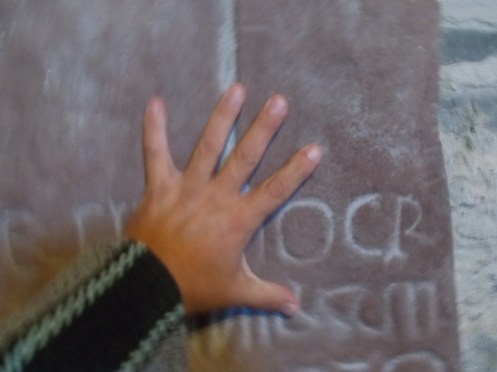
So also, when you see all these things, you know that he is near, at the very gates — Matthew 24.33
ACCORDING TO VATICAN records, October 26th is the Feast of St Gwynno, who seems most likely to be the 6th Century Celtic church leader behind the name given to the church of St Gwynour. Gwynno was a follower of Illtyd and both probably lived for some time on Caldey Island, where they were priest-monks, before travelling between Wales, Ireland, Cornwall and Brittany as missionaries, setting up llan communities and centres of spiritual and philosophical learning.
In the picture above, you can see me putting my hand on a stone known as “The Ogham Stone” which is now on the wall of the ancient abbey chapel on Caldey Island. The stone is marked with the ancient Celtic language along the edges, as well as Latin inscription on the face of it. A cross is carved in there too. The stone is dated from 5th or 6th Century so perhaps Gwynno touched it too; who knows? Anyway, I had gone there in the night while staying on the island with the monks a few years ago. I was a little scared going there alone through the dark woods to the ruined abbey but I wanted to spend some time there in prayer while the tourists weren’t around. I suppose I wanted in some way to connect with the Celtic church of my ancestors and touching the stone was a kind of physical metaphor for that. Imagination and interpretation can be fed by such things but, for me there was more in the touch than just intellectual projection. At deeper levels of my consciousness, there was a dissolving of the centuries, of time and matter, where all time/place becomes one time one place.
This Sunday is, for various parts of today’s church body, Bible Sunday. The Bible can be read as a history book, connecting us with our ancestors in faith, or as a manual to live by, full of moral codes and commandments from God Almighty. It can be the unfolding theology of peoples over millennia. There is of course value in such reading styles but each have a tendency to objectify God and so place God at a distance. The Bible is far more than stimulation for religious or existential theory or judgemental morality. Scripture is alive and it can speak to any and all of us directly and in the moment of reading. It contains the very breath of God, as we do, as does everything and everyone around us. It has the power to connect us with it all. If we contemplate it and let it breathe in us, Scripture brings God closer to us than any sense of touch.
The Unknowing
•October 22, 2017 • Leave a Comment
When the people saw that Moses delayed to come down from the mountain, the people gathered around Aaron and said to him, ‘Come, make gods for us, who shall go before us — Exodus 32.1
I CAN’T REMEMBER a time in my life when I was not grappling with church and church history. As a child, I knew Christ but I often strained to try to see him through the tall legs that seemed to be so many then, stretching up towards the up-turned boat ceilings of St Illtyd’s and St Mary’s churches or the mighty roof of Brecon Cathedral. I didn’t like Sunday School and I hated the smell of fake coffee and lipstick and the loud guffaws of the giant ones. I literally ran from stodgy and dry sermons about some well-dressed, well connected establishment moralist, whom I could not equate with the Galilean vagabond I met in the pages of my Bible and in the daffodil-dreaming prayers of my heart, whom I loved so much and wanted to follow into the light or into the deepest, darkest dark. Either way didn’t matter to me because I simply knew he’d already gone there ahead, though he felt so close.
Later, I travelled with him on the roads and rough-tracks of Europe and then I fought the Romans, the Empire-simpering Reformationers and anyone else who obscured and distorted the Christ I knew in every fibre and cell of my body and being. I wrestled with them in the free-mind University of wild, west Wales…oh I fought and screamed into the mountain wind.
But I heard sweet whisperings of church long ago that moved through this very land, like mist, like beautiful, un-named truth. I read the sparse-word wisdom of desert ones who seemed to know the One whose fire burned in me and they opened doors for me in the mist I hadn’t even noticed were there. I loved them and I love them still. And I know these mothers and fathers of faith were/are church. I still struggle with churchhh. Every day. Sometimes I wake up with the fight nagging on, other times I fall asleep with it. It makes me so restless, until I return to the Peace.
When did the church get tired of waiting for the Christ to come down from the mountain? I don’t know. Maybe I don’t need to know. Because all the time, in the world, in hearts of disciples, within the church and without, there is also and always…the unknowing…
Let the idols of religion fade, and melt and break. Shake their dust from your sandals and behold the Christ Who Is.
When We Are Weak
•October 21, 2017 • Leave a Comment
Moses said to the Lord, ‘See, you have said to me, “Bring up this people”; but you have not let me know whom you will send with me… Now if I have found favour in your sight, show me your ways, so that I may know you…’
JHWH said, ‘My presence will go with you, and I will give you rest.’
— Exodus 33.12-14
THIS LAST WEEK, we had the latest Gower Ministry Area Council meeting at Oxwich. Much excellent discussion was had. Personally, I am not good at meetings and, though I always attend them with a desire to stay calm and open to all, there were once again some flashpoints for me in which, invariably, my passion rises and I fail to retain strict meeting etiquette. Fortunately, people, who have experienced such situations, are usually patient with me and they were so this week. Oh, I should say I am certainly not the only one in whom the fire is not easily tamed! After all, we attend such meetings (though most of us probably wouldn’t if we could think of another way to do it) because we love God, love the Church in Wales, love church universal, love Gower.
But after the passion is spent, and the words have fallen to the sand or dispersed into the mystic Gower ether, I am very often left simply conscious of my smallness, my lack of significance, my inability to affect the ministry my head seems to think my heart yearns to effect.
In many walks of life, such confession might precede some kind of letter of resignation. My guess is that Moses, in the quotations above, was contemplating something like it. But church is not “many walks of life”. Church is a response to God’s calling to humanity and to all creation. Church is not even simply a humanly conceived response, but the Christ-bride breath of the Holy Spirit herself.
It is when we feel small and helpless, that God most powerfully reveals God’s Presence to us, covering our eyes with God’s hand so we are not burned up in the brightness, until the radiance has passed and we can see that God just passed by before us. God bless all you do in His Name.
When we are weak by RS Thomas
When we are weak, we are strong. When our eyes close on the world, then somewhere within us the bush burns.
When we are poor and aware
of the inadequacy of our table,
it is to that,
uninvited,
the guest comes.
BORNE IN CHRIST
•September 21, 2017 • Leave a Comment
Truly I tell you…
TELLING THE TRUTH is seldom easy. Appeasement, turning a blind eye, blaming circumstance or another, and more so if that other is not present; these are easier. But the truth, however avoided or suppressed never goes away. When Jesus speaks to us, whether through Scripture, through prayer or nature, through the eyes or voice of stranger or companion, he looks into our very soul, “Truly, I tell you…” And he calls us, who would be “Followers of the Way”, to do the same.
“If another member of the church sins against you, go and point out the fault”
Sin and fault are English translations of Jesus’ words and they carry a judgementalism alien to their intention. Hurt might be better. Go and tell her/him how you are hurting because of something they have said or done or are doing. Start with the pain. Ask why. Beyond that, “I see that you are hurting too. Have I done something to hurt you?” Be prepared to listen. Let the direction be reconciliation not retribution, and certainly not “comp”!
“…if the offender refuses to listen even to the church, let such a one be to you as a Gentile and a tax-collector”
Humility is necessary for reconciliation. Humility is not backing down because conflict has not been averted by gentle directness. If the offender has not yet found the humility to listen even to the church (ecclesia, Matthew’s term, does not refer to church hierarchy but to the people of the church community), then they place themselves at this moment outside that community. However, Gentile and tax collector are far from lost causes to Jesus! It is to the outsider he goes. And when he goes, he says, “Truly I tell you…” And he encourages us, “The first will be last, and the last will be first…” Pick up your cross. Tell the truth. Take the pain and you will find that the pain is already borne.
IMPEDING THE FLOW
•September 21, 2017 • Leave a Comment

… the lord of that slave released him and forgave him the debt. But that same slave, as he went out, came upon one of his fellow-slaves who owed him a hundred denarii; and seizing him by the throat, he said, “Pay what you owe.” (Matthew 18.27-28)
JESUS WAS/IS NOT a teacher of morality, offering a code of conduct that, if adhered to step by step, leads to righteousness. Jesus is a teacher of wisdom (Greek σοφία sophia; Hebrew חָכְמָה chochmah). The aim of Jesus’ wisdom teaching is to unblock in us and in the world that which impedes the flow of God’s grace.
Through God’s grace, WHAT IS is. According to the prologue of John’s Gospel, Christ is himself the eternal word/logos/being through which all being came, comes and will come. But for God’s grace to be God’s grace, free will is a given. Absolute love might conceivably be poured out from the centre of the cosmos and travel through all space and time, all being and every being, unimpeded. At least, per human logic it might. However, the receiving of such unimpeded flow would, without free will, be wholly passive and thus rendered unconscious, soul-less even. Without free will (and with it the seemingly boundless capacity to use it destructively!) ‘human being’ would be better described ‘android being’.
OK, this might be getting complicated and there’s only a little space left. Look. Jesus’ story this morning, the slaves and forgiveness of debts, is about the divine flow of God’s unconditional love. The first slave seems to have repented and his master has forgiven him. Forgiveness has unblocked the divine flow for the slave because the debt has been eased and made possible to remove. THAT DOESN’T MEAN HE CAN JUST GO AND DO WHAT HE WANTS NOW! But it does mean the block has gone and he can stand once more in the full flow of God’s grace. However, the slave has learned nothing. No wisdom has replaced that which was impeding his life (sin and debt have their roots here), and straight away he grabs his own debtor by the throat!
The slave has thrown back into the flow a giant rock in the place of the earlier impediment. The flow is blocked. The slave has disrespected his new-found freedom and handed himself over ‘to be tortured.’
DON’T WASTE YOUR WILDNESS
•August 5, 2017 • Leave a Comment
Now…Jesus took with him Peter and John and James, and went up on the mountain (to be alone) to pray. And while he was praying, the appearance of his face changed… (Matthew 17.1-2)
“WE ARE ANIMAL in our blood and in our skin,” wrote Jay Griffiths in her book, Wild: An Elemental Journey. “We were not born,” according to her way of feeling or thinking, “for pavements and escalators but for thunder and mud…What is wild cannot be bought or sold, borrowed or copied. It is. Unmistakeable, unforgettable, unshamable, elemental as earth and ice, water, fire and air, a quintessence, pure spirit, resolving into no constituents. Don’t waste your wildness: it is precious and necessary. Wildness is the universal songline…”
It is no coincidence that Peter, John and James are in the wild when they experience Christ transfigured, when they catch a glimpse of their familiar, yet enigmatic spiritual leader, Jeshua, as he really is. Jesus has taken them away from the crowds, up into the wilderness, where so often he goes alone to pray. He shows them his own spiritual path and the wilderness paths of the prophets and mystics from before and after their own allotted time on this earth.
Many of our churches in Gower are built on the sites of the cells of the earliest Celtic saints, who came here because it was a wild place. As far as European cultures were concerned, Gŵyr was a near-island sticking out from the edge of the world into the unknown, untameable sea. Like the Desert Fathers, with whom it seems the early Celtic church was in communion, our mystic ancestors learned to read the beautiful, dangerous land-seascape, not as consumers, extracting what is useful, informative or entertaining, but as lovers, desiring to taste and smell its material/spiritual secrets, lingering over it, drinking it into the soul, until Christ in them be transfigured and made bright white in wild, holy Light.
It’s holiday time now and some of us will, quite ironically, go way from this place to seek solitude and so be refreshed; may the time be deeply blessed. But there will also be many coming to Gower seeking what for most of them isn’t even consciously known. In Christ, may we be conscious of their hunger and may we seek to help whoever we can, quietly and gently, connect with this wild, holy place and, through this, may Christ awaken to them the Christ in them.
Bendith Duw i chi. Fr Tim
The Soil And The Seed And The Light
•July 15, 2017 • Leave a Comment“…hear our prayer which we offer for all your faithful people,
that in their vocation and ministry they may serve you in holiness and truth to the glory of your name (from today’s Collect)
 TODAY, WE WILL hear again Jesus’ famous parable of the sewer and the seeds, as well as a story about the early descendants (grandsons) of Abraham, to whom the three major Middle Eastern faiths trace their roots, and some Pauline teaching about flesh and spirit. We will praise God in hymns and psalm, whose word we will acclaim, “a lamp to my feet and a light to my path.” So how do we deal with this word? How can we approach it? How do we apprehend it, let it take root in us? How can we learn from it and move on, wiser, more in touch with God and creation, with ourselves and our fellow beings, the earth, our lives, history, more able to serve God “in holiness and truth?”
Well, to be simply asking these questions is a beginning, because to actually want to ask them is indicative of our intention. While I was praying with someone this week, focusing the prayer on some tough things going on in their life and in the lives of their loved ones, it struck me afresh that our faith is not in a God that manipulates the circumstances of our lives and makes this or that happen (this is an Ancient Grecian type of belief; I’ve said enough about that recently) but in the “ground of all being”, I AM, one true God who loves all and who gives all free choice. So, if our intention then is to exercise our free will to ask the deep questions, we are already working the soil into which the seeds of the sewer, Jesus Christ, are all the time falling.
Intention is a key to allowing the word, freely given and without coercion, to enlighten our path. This intention, once raised to our consciousness, will move us on through the layers of our existence, exposing to that which we really are, the eternal part of us, our true nature and that which is false or misguided. The word, be it embedded in our Bibles, our surroundings, the events of our lives, music, art, science…everything… will expose these things but our intention removes the veil. Each one of us is a field of good soil. But we also have places in that field which are barren, rocky and which provide easy pickings for the birds. If our intention leads us to contemplate the word openly and in truth, we will soon realise this. But as soon as we do, we begin, in the light of that same word, to till the soil.
CHOOSE LIFE
•June 26, 2017 • Leave a Comment
“Those who find their life will lose it, and those who lose their life for my sake will find it.”
IN THE PICTURE, Jesus is speaking to a Nazi soldier, whom it seems he has caught up with on a wilderness road. The idea of a Nazi soldier is of course a strong metaphor but it could easily be transferred to any other symbol of political, nationalist, religious or philosophical identification. At the deeper, spiritual levels, the conversation might parody the conversations of our inner lives, between our received and conceived egoic, worldly consciousness and the eternal divine in us. The soldier seems to have been marching, alone on this road. His steps still suggest the remnant of the march; there is still the vestige of the quickness of step, the straightness of direction and the largely unconscious, programmed adherence to its impetus. Contrast this with the openness and unhurriedness of Jesus’ movement. Christ has already disarmed the soldier and is carrying the burden of both gun and survival pack, the very things the soldier is programmed to believe he needs for his own survival and the propagation of his perceived cause, the mission of his programmers. There is now a slowing of the march, the right foot is drawn toward the Christ. He is listening to the Teacher, or confessing, or both. He is on the road to Life now, still in the wilderness for sure but there is yet light before sunset, or perhaps the new dawn is rising…
The weapon and the survival pack have been relinquished for now. Ahh… What relief… Bliss. But will the soldier ask for them back? Though Jesus will carry them and relieve the burden of them, he has not confiscated them. Will the soldier trust this newfound or re-experienced lightness of being, or will he wake in fear, like St Peter out of the boat on the Sea of Galilee, and snatch them back for fear of his life?
Christ’s offer of Life is open. Free. To accept the offer is to know love unconditional, cosmic, material, spiritual harmony. Do you trust it? Do you believe Him? Can such beautiful freedom really be what you, yes tiny little you, be made for? Can you give Christ your gun and your survival pack? Give it over, take it back, give it over… Huh?

 Tonnau Duw ('God's waves') Fr Tim Ardouin